Ushering in a Future-Proof Era of Cooling Innovation
WHY VAPOR CHAMBERS?
Modern CPUs generate highly concentrated hotspots that traditional copper bases cannot distribute evenly. A vapor chamber uses liquid phase-change technology to spread heat rapidly across its surface, ensuring every heat pipe is utilized more efficiently.
Heat is then transferred from the coldplate through the vapor chamber into the heatpipes and fin stacks, delivering faster, more uniform cooling for today's high-performance Intel and AMD processors.
Vapor Chamber vs Traditional Copper Base
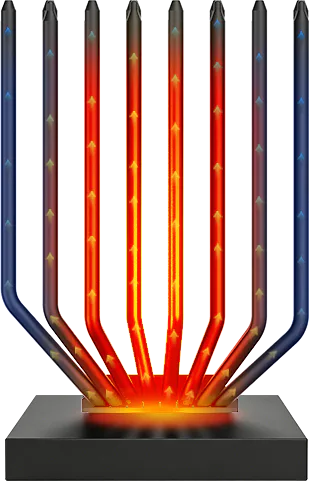
Traditional Copper Base
Heat concentrated at center Higher thermal resistance Lower heat transfer efficiency Localized hotspots Slower transient cooling
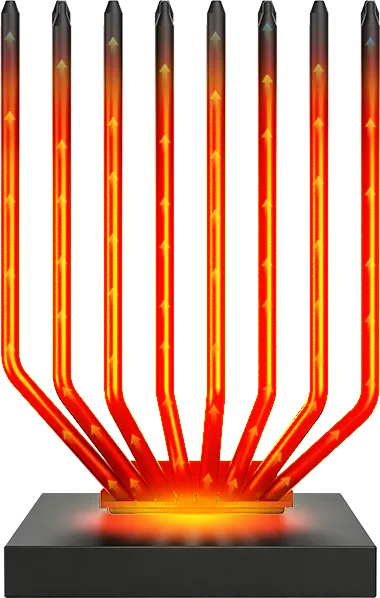
Vapor Chamber
Even heat distribution Lower thermal resistance Superior heat transfer Excellent temperature uniformity Faster transient cooling
Thermal Resistance
Intel® Core™ Ultra 9 285K @300 W
*Tested on the Same Heatsink with Different Base Designs
Base Type
Thermal Resistance
Thermal Conductivity
Copper Base
0.238 °C/W
401W/(m·K)
Vapor Chamber Base
0.225 °C/W
20000 W/(m·K)
VC 1.0 VC 2.0
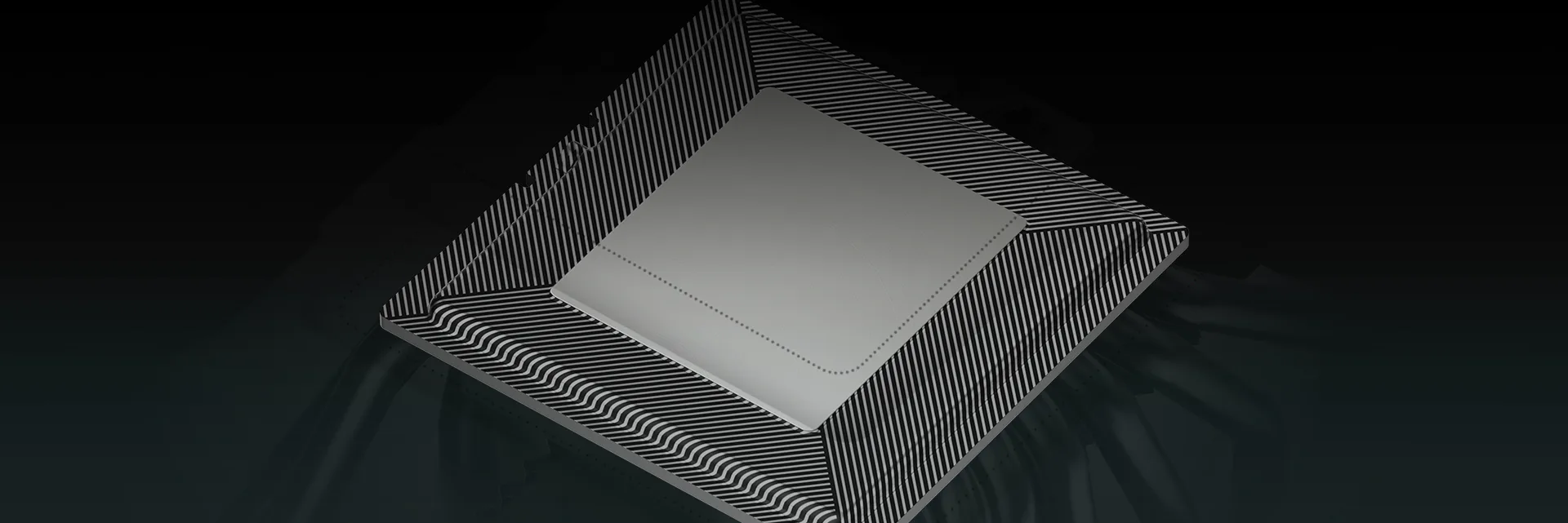
VC 2.0 increases the CPU contact area, enhances overall structural strength, improves surface flatness of the VC. An enhanced capillary structure increases heat dissipation efficiency, while an optimized copper pillar layout strengthens the internal structure and improves heat transfer. Compared to the first-generation, VC 2.0 delivers up to a 15% improvement in cooling performance.